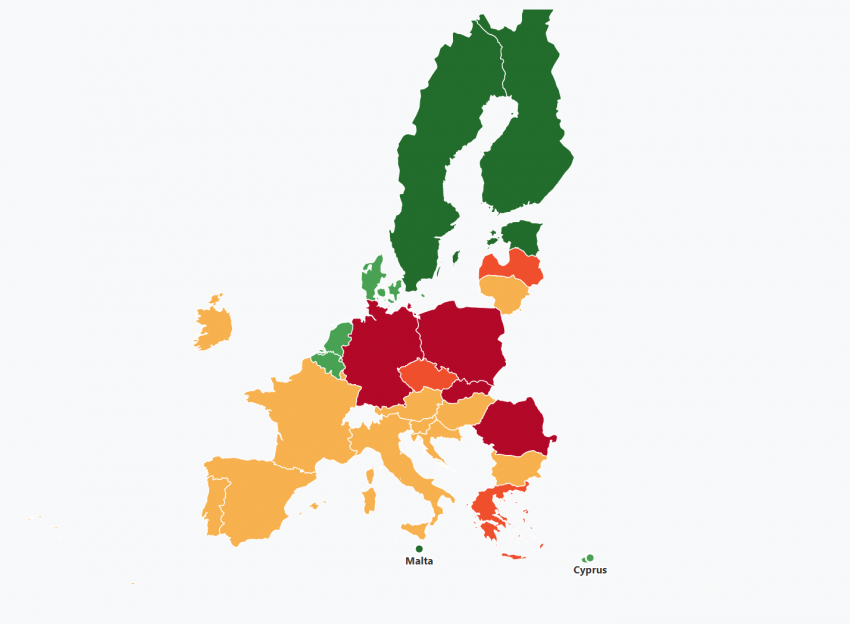
EU Digital Launchpad Index
Why Digital Infrastructure Decides Startup Success
In the modern world, every startup founder dreams about turning a concept that one day suddenly appeared in their head into something much bigger. Yet, not every idea manages to evolve from a simple concept to a finished product or service. It faces high competition and trend shifts in the corporate world. As a result, entrepreneurs give up on the early stages, and the idea remains a product of imagination.
Today, most of the operational tasks crucial for start-up development can be easily accessed in a digital environment. Moreover, any startup idea can be designed and developed within a single digital space. There is no necessity of having any physical equipment, space, or storage – everything can be done through IT solutions. According to recent studies, more than 50 new tech unicorns have been launched between 2020 and 2023 in the European Union. Today, the market of privately-held startups is worth €561 billion. The data proves that the digital ecosystem in Europe indeed can assist new startups on early stage without big financial investments. But is it really that easy to develop a startup in every EU member state without potential risks and losses?
We, at files.fm, value creativity, and our services help bright minds turn their unique concepts into ready-to-use services and products through the cloud solutions we offer. Thus, it is worth identifying which EU country offers the most reliable digital foundation for startups in 2026, as we believe any small idea can turn into an empire that could change the modern world.
How We Built the Index
Our study ranked European countries where tech startups have the best conditions to launch and scale by combining three key dimensions: digital infrastructure readiness, talent market dynamics, and venture capital access. Each metric was equally weighted into one composite ranking.
The Three Core Metrics of Digital Startup Readiness
DESI Score for Business
Our team took the Digital Economy and Society Index indicators and combined the business-relevant ones to create a new index that will reflect each country’s digital infrastructure quality for startups. The index combines 7 equally weighted indicators: percentage of enterprises using cloud services, Digital Intensity Level, High-Speed Internet Coverage, ICT Specialist Employment rate, percentage of population with basic or above basic digital skills, percentage of enterprises using AI, and Digital Public Services for Businesses Score. A higher score means the country has a better digital infrastructure and workforce availability & accessibility.
ICT Sector Salaries
The median software engineer salary mirrors the talent market competitiveness and the cost of building a local team. Higher salaries indicate higher competition and market maturity, while lower salaries offer cost advantages but can also mean lower quality of the future product.
VC Funding Activity Score (WIPO)
This metric, originally calculated within the confines of WIPO’s Global Innovation Index, represents venture capital deal density – how many VC funding rounds occur relative to a country’s economic size. It’s calculated as the number of VC deals per billion PPP$ GDP, then normalized to a 0-100 scale where 100 represents the most active VC ecosystem globally.
Corporate Income Tax Rates
CIT is a contextual metric and was not included in this ranking, since taxes do not affect how easy it is launch a business. However, it’s an important metric to consider before choosing where to register a firm in the EU.
Data were sourced from the European Commission DESI, levels.fyi, Global Innovation Index and the Tax Foundation were collected in February 2026.
Key Findings
- Sweden tops the ranking with a Digital Launchpad Index of 70.57, leading in ICT specialist employment at 8.6%.
- Nordic countries claim 3 of top 5 spots: Sweden (1st), Finland (2nd), Denmark (5th).
- Estonia achieves a perfect VC Activity Score of 100 – the highest venture capital deal density in the EU relative to GDP size.
- Small markets outperform large economies: Estonia (1.3M population), Malta (520K), and Cyprus (900K) all rank in the top 7.
- Finland is the only EU country with a perfect DESI Business Score of 100, demonstrating the strongest overall digital infrastructure.
- Malta achieves 100% high-speed internet coverage – the only EU country with complete connectivity.
- The Netherlands has the highest digital skills rate at 82.7% of the population, yet ranks only 8th overall.
- Software engineer salaries range from €2,270 (Greece) to €7,173 (Netherlands) – a 3.2x difference that directly impacts startup runway.
- Cyprus ranks 7th with the EU’s second-highest VC Activity Score (64.5) and lowest corporate tax rate (12.5%).
- Denmark leads AI adoption at 26.43% of enterprises using AI tools, yet this doesn’t secure a top-3 placement.
- Internet infrastructure quality plateaus above 85% – Malta’s perfect scores and the Netherlands’ 98.4% coverage don’t guarantee top rankings once connectivity crosses this threshold.
The Top 10 EU Countries for Digital Startups
#1 Sweden – The ICT Talent Leader
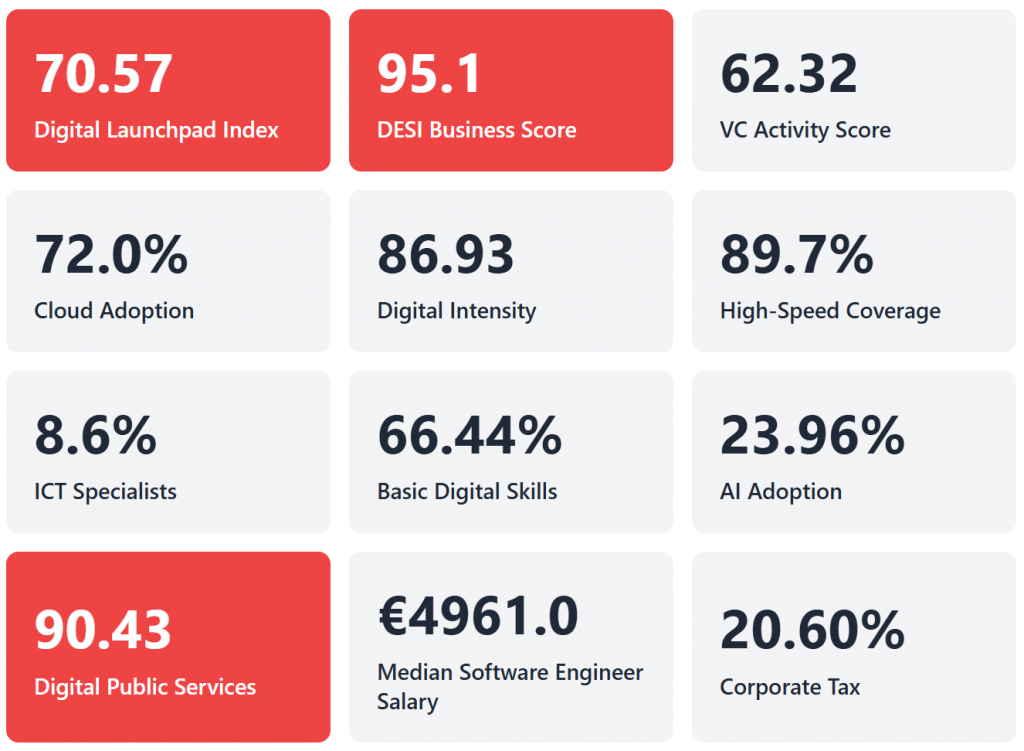
Sweden tops the EU rankings as the best country for digital startups with a Digital Launchpad Index of 70.57. The country leads in ICT specialist employment with 8.6% of residents working in this sphere, while the median software engineer salary is €4,961, 1.4 times lower than hiring a professional in Denmark. With high cloud adoption among enterprises (72%) and most public services being digitalized (Digital Public Services score: 90.4), Sweden offers a strong tech culture and adoption where any startup dream can come true inside the digital space.
#2 Finland – The Digital Excellence Leader
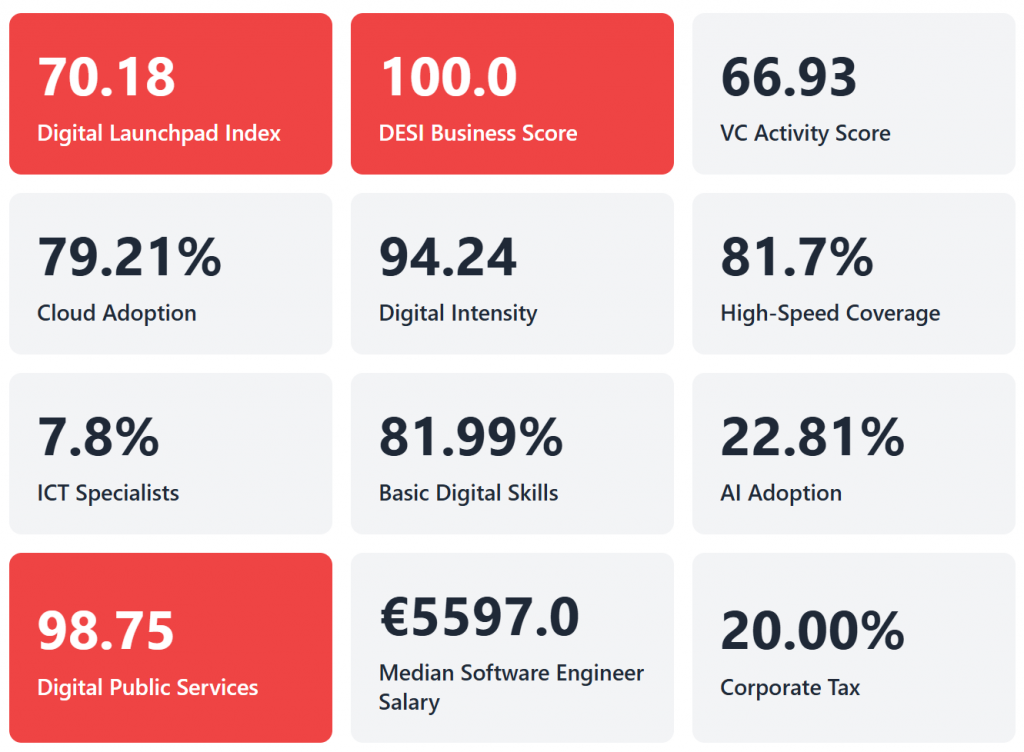
Finland ranks #2 with a digital launchpad index of 70.18. The country achieves a perfect DESI Business Score of 100—the only EU nation to reach this milestone. With 94.24% digital intensity and 79.21% of enterprises using cloud solutions, Finnish companies are deeply integrated into digital operations. Moreover, 81.99% of residents have basic or advanced digital skills—the highest in the EU. The country demonstrates 98.75 in the Digital Public Services score and 7.8% ICT specialist employment. A new start-up would need to spend an average of approximately €5,597 per month to hire a software engineer. This cost falls somewhere in between what Denmark charges (the highest rate) and what Sweden charges (mid-tier cost). Finland provides both world-class digital infrastructure and a large pool of technical talent, making it a great place for start-ups to grow without any limitations.
#3 Estonia – The Digital-First Trailblazer
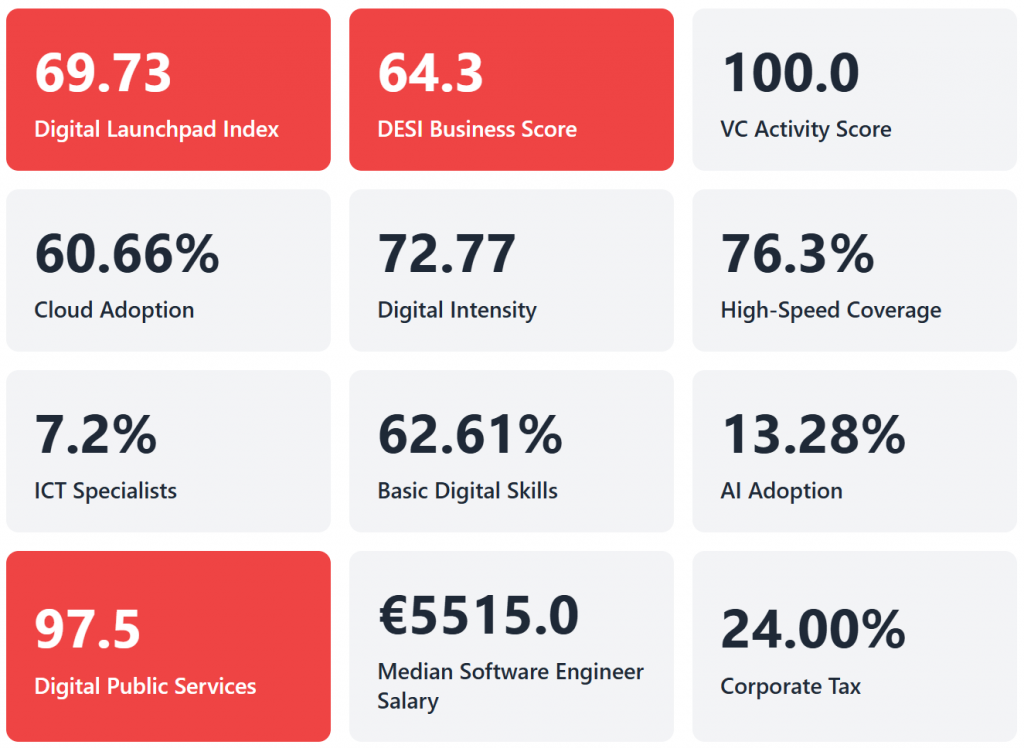
Estonia, the IT capital of the Baltic states, ranks 3rd by offering a favourable digital landscape for startups with a digital launchpad index of 69.73. With the highest VC Activity Score in the EU of 100, the country’s venture capital funding is more accessible here than in any other EU member state. The country demonstrates the highest Digital Public Services score (97.5), and new companies can easily manage all necessary operations within the online space. With 7.2% ICT specialist employment and a median software engineer salary of €5,515, Estonia offers technical talent at costs below Western European rates.
#4 Malta – The Perfect Infrastructure Island
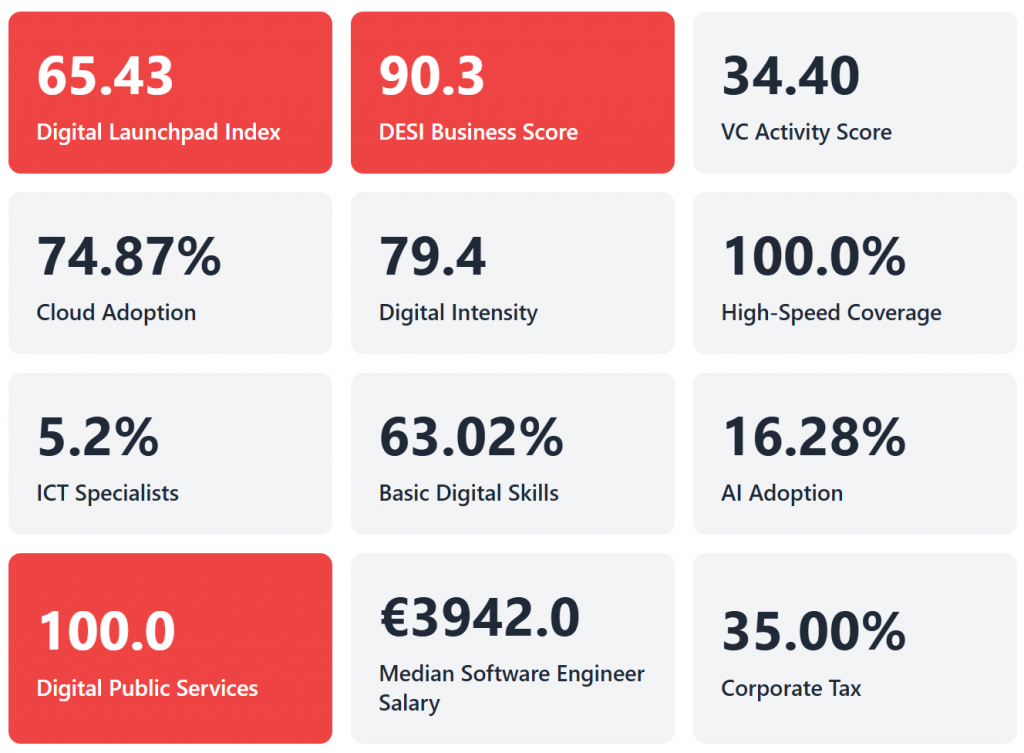
Malta ranks 4th with a digital launchpad index of 65.43. It has 100% high speed internet coverage over its entire area. It also reaches 100 for the digital public services index, matching Estonia on that measurement. 74.87% of the companies in Malta use cloud solutions, and 16.28% of them utilize AI-based tools. Moreover, 63.02% of residents are equipped with basic digital skills, while 5.2% of the employed population is considered qualified ICT specialists. The average salary of a software engineer in Malta is €3,942, which is 2.9 times lower than in the Netherlands and nearly half of salary paid in Denmark. Despite a 35% corporate tax headline rate, Malta’s shareholder refund system reduces the effective rate to 5%, making it one of the most attractive countries for startups looking to distribute dividends.
#5 Denmark – Digital Public Services Pioneer
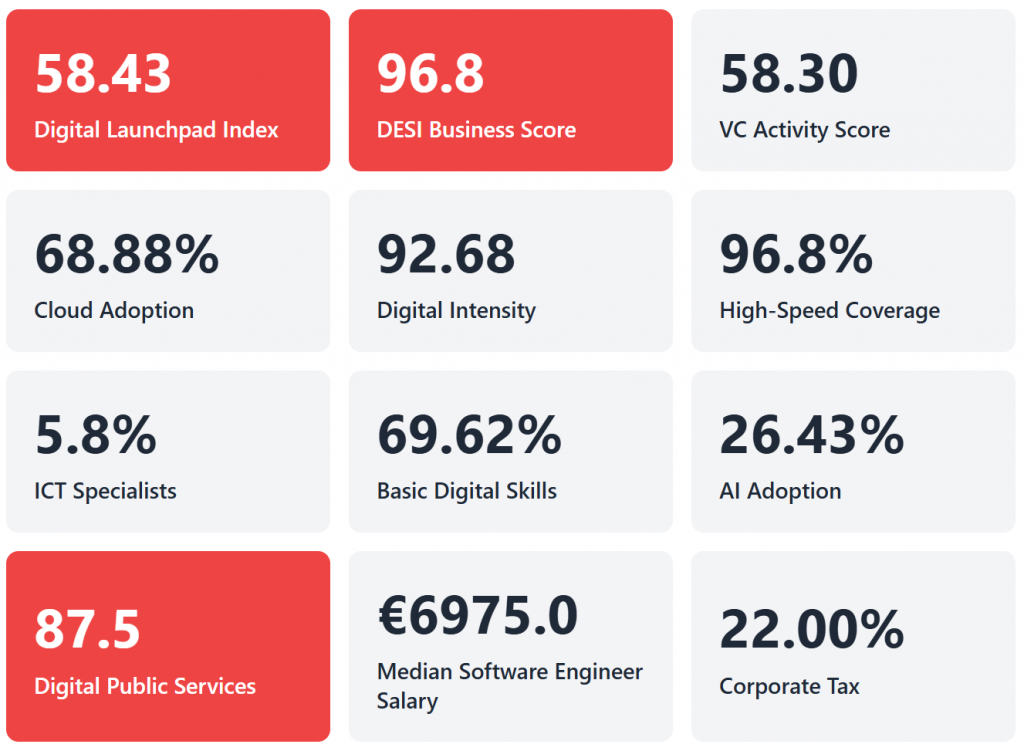
Denmark ranks 5th with a digital launchpad index of 58.43. With a DESI Business Score of 96.8 and a corporate income tax of 22%, the country offers favorable conditions for new entrepreneurs. Moreover, 26.43% of local enterprises are using AI-based tools—the highest rate in the EU—meaning the country strives towards incorporating new technical trends, while 68.88% of all companies are using cloud solutions for functionality. The country also demonstrates strong digital literacy with 69.62% of residents equipped with basic or advanced digital skills, while 5.8% of the employed population is considered qualified ICT specialists. A new startup will have to pay a median salary of €6,975 to hire a professional software engineer, but the final result, of course, pays off potential costs.
#6 Belgium – The Balanced Digital Powerhouse
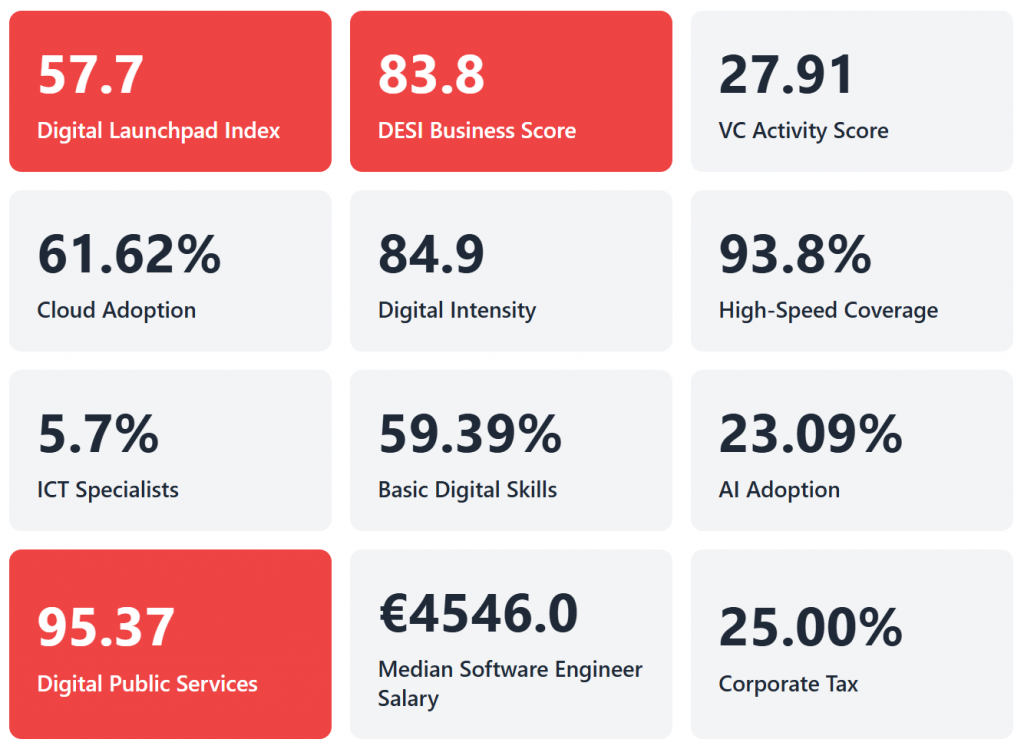
Belgium ranks 6th with a digital launchpad index of 57.7, offering an excellent balance across all metrics. With a high digital intensity index (84.9) and digital public services score (95.4), companies established in Belgium extensively use digital solutions in their operational matters. Moreover, almost 60% of residents are equipped with basic digital skills, while 5.7% of the employed population is considered qualified ICT specialists. Not only is it possible to hire a professional, but a company can also teach a junior specialist to perform the necessary duties. A new startup will pay a median salary of €4,546 to hire a software engineer, notably lower than Denmark’s €6,975, while maintaining strong technical talent availability. With 23.09% of enterprises adopting AI tools and 61.62% using cloud solutions, Belgium provides a balanced digital foundation where every startup concept has the infrastructure support needed to scale.
#7 Cyprus – The High VC Activity Contender
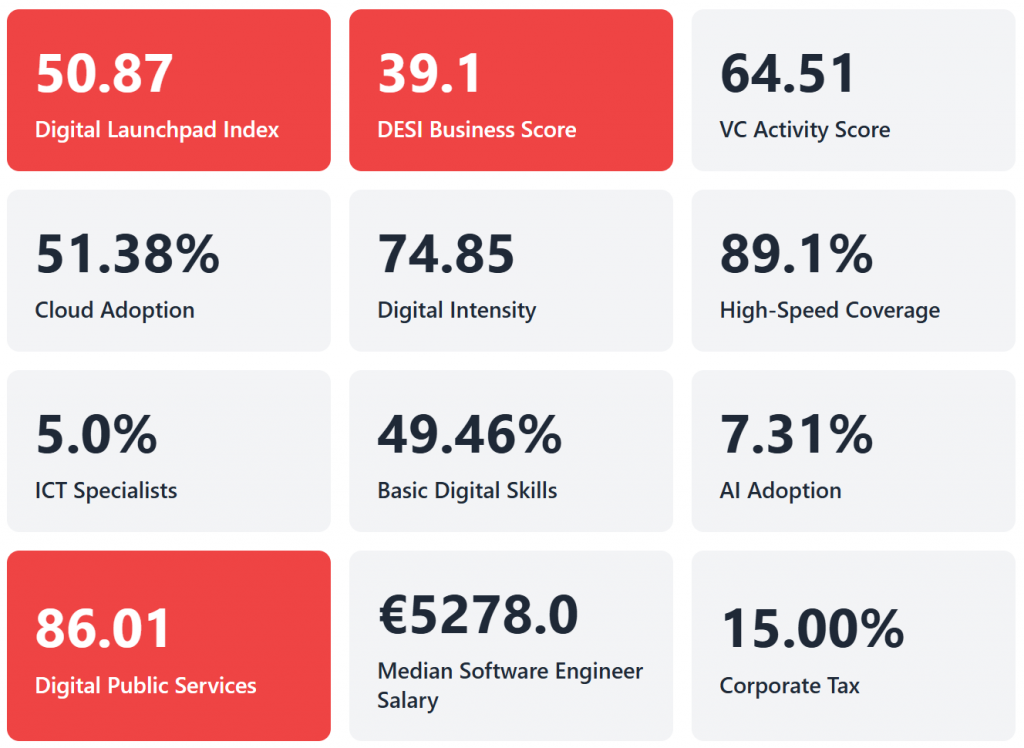
Cyprus ranks 7th with a digital launchpad index of 50.87, standing out with a VC Activity Score of 64.5—the second highest in the EU after Estonia. With 74.85% digital intensity and a Digital Public Services score of 86.0, companies established in Cyprus can manage most operations within the digital space. Moreover, almost 50% of residents are equipped with basic digital skills, while 5% of the employed population is considered qualified ICT specialists. Not only is it possible to hire a professional, but a company can also teach a junior specialist to perform the necessary duties. A new startup will pay a median salary of €5,278 to hire a software engineer. With 51.38% of enterprises using cloud solutions and a corporate income tax of just 12.5%, Cyprus combines favorable tax conditions with an active funding environment for startups planning capital raises.
#8 Netherlands – The Gateway to European Markets
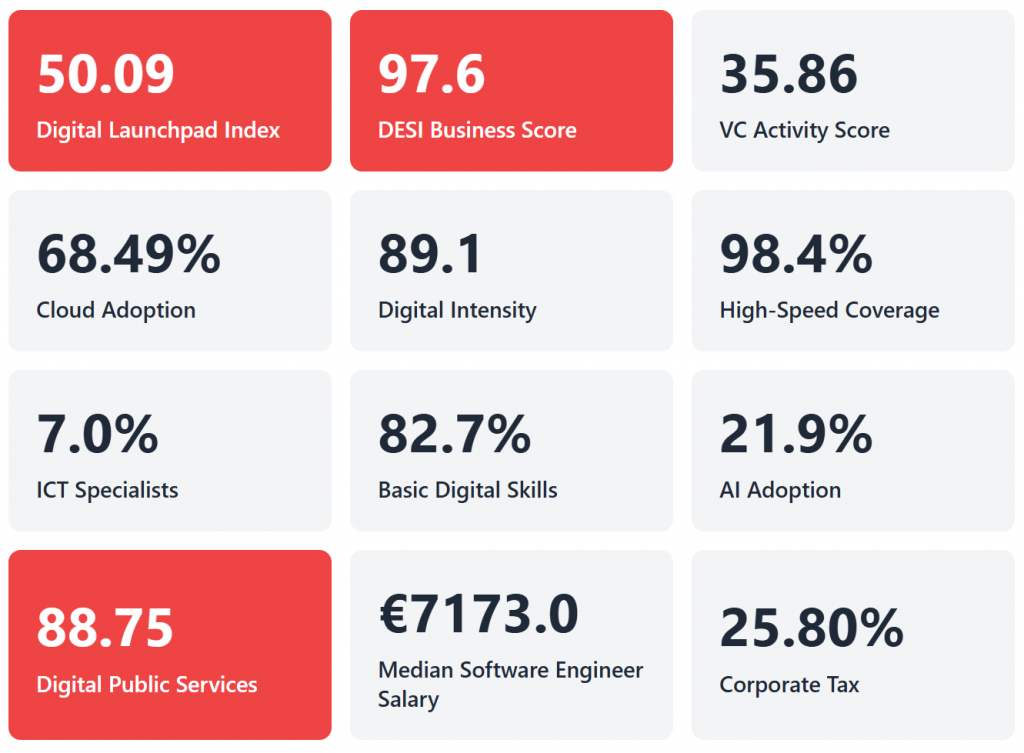
The Netherlands ranks 8th among EU countries for establishing a startup with a digital launchpad index of 50.09. 98.4% of the country’s land is covered with high-speed internet connectivity, as well as 82.7% of the local population are adapted to the usage of digital solutions—the highest digital skills rate in the EU. By being the best in the two aforementioned indices, the Netherlands is a perfect place for staying connected to the World Wide Web from any point in the country, finding local customers who are skilled enough to use a product or service a startup offers. A new startup will have to pay a median salary of €7,173 to hire a professional software engineer—the highest rate in the EU—but access to the strongest digital talent pool makes the investment worthwhile.
#9 Spain – The Emerging Digital Hub
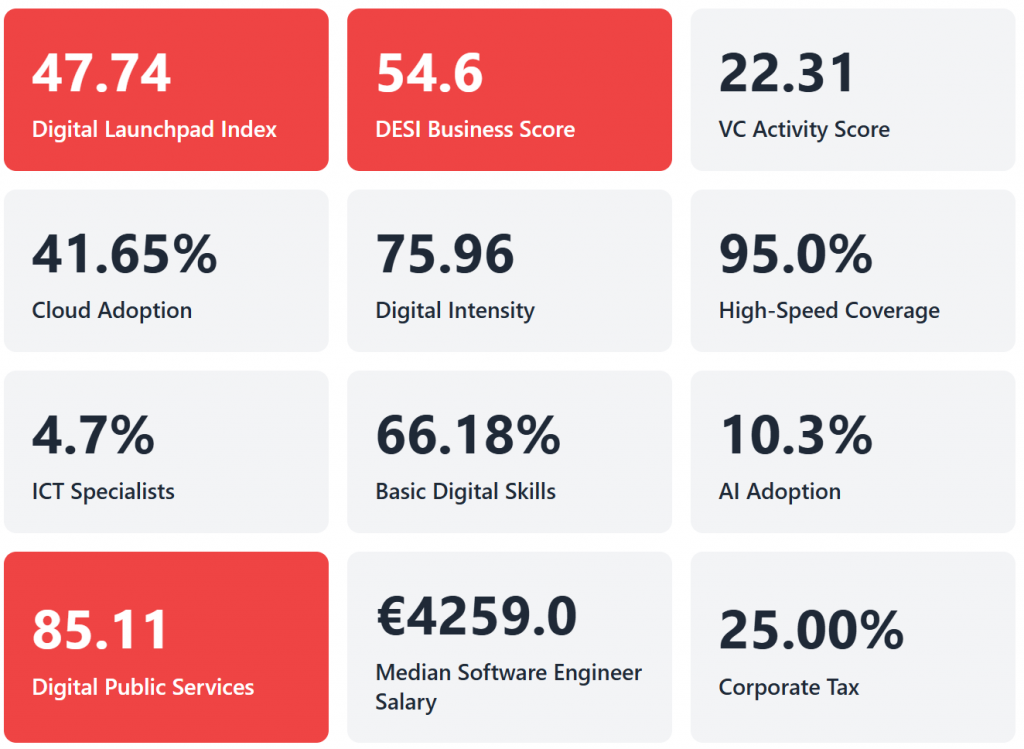
Spain ranks 9th with a digital launchpad index of 47.74, offering reliable foundation at low costs. 95% of Spain’s territory has high-speed internet coverage, while 66.18% of residents are equipped with basic digital skills. Moreover, 4.7% of the employed population is considered qualified ICT specialists. A new startup will have to pay a median salary of €4,259 to hire a software engineer, which is nearly half the cost of hiring in the Netherlands. With 41.65 % of companies using cloud solutions and a digital intensity of 75.96 %, Spain offers a combination of reliable solutions and low operating costs- a perfect choice for entrepreneurs who carefully manage their finances.
#10 Lithuania – The Baltic Rising Star
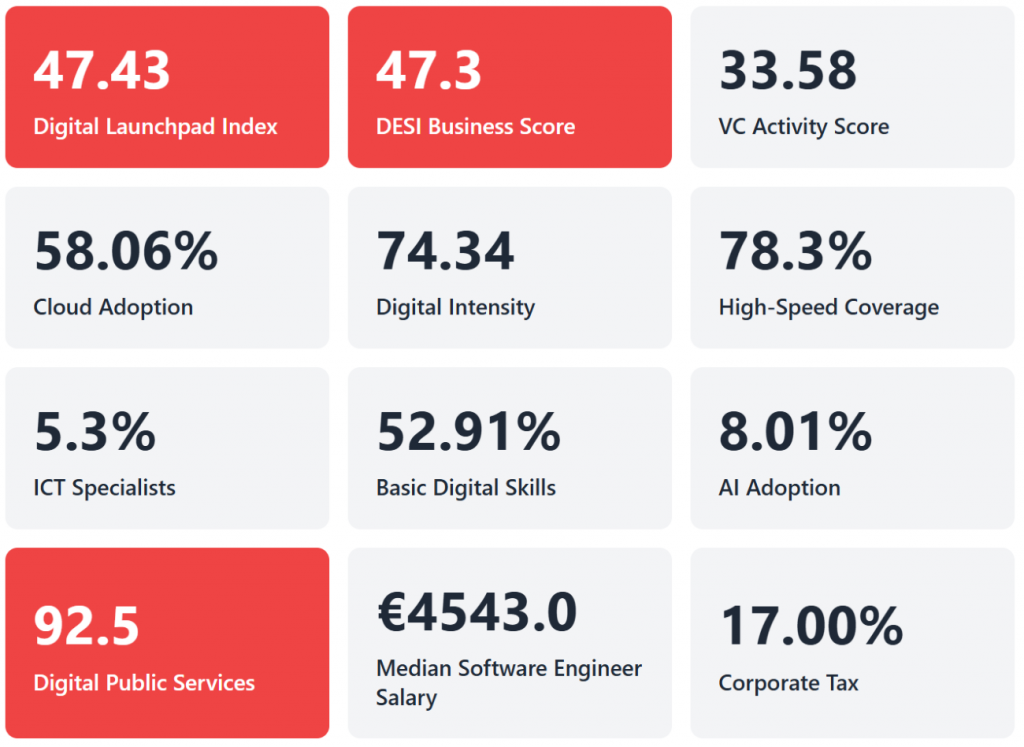
Lithuania ranks 10th in terms of its digital launchpad index (47.43) through the combination of having the lowest corporate tax rate among top performers at 17%, while offering a high-quality digital infrastructure. The country demonstrates a 92.5 Digital Public Services score, and new companies can manage most operations within the online space. Moreover, 52.91% of residents are equipped with basic digital skills, while 5.3% of the employed population is considered qualified ICT specialists. Not only is it possible to hire a professional, but a company can also teach a junior specialist to perform the necessary duties. A new startup will pay a median salary of €4,543 to hire a software engineer. The country offers reliable infrastructure at lower costs than Western markets, though without Denmark’s talent density or Estonia’s digital services maturity
Corporate Tax Comparison
Our team excluded corporate tax from our ranking because it matters after profitability, not at launch. But taxes are an unskippable part of the business operations. The EU’s corporate tax landscape ranges from 9% in Hungary to 35% in Malta.
Top-10 lowest CIT in the EU:
| Country | Combined Statutory Corporate Income Tax Rate |
|---|---|
| Hungary | 9.00% |
| Bulgaria | 10.00% |
| Ireland | 12.50% |
| Cyprus | 15.00% |
| Romania | 16.00% |
| Lithuania | 17.00% |
| Croatia | 18.00% |
| Poland | 19.00% |
| Finland | 20.00% |
| Latvia | 20.00% |
However, there are some tax systems worth mentioning separately:
- Estonia has a unique system worth highlighting. It applies 0% corporate income tax on retained and reinvested profits, only taxing the distributed profits at 24%.
- Malta is seen as having a high 35%. However, the shareholder refund system allows for this to be reduced to an effective rate of 5%. The refunds allow shareholders to claim back 6/7ths of what they have paid in taxes when the dividend is distributed, making Malta the most tax-efficient jurisdiction within the European Union, even though it is seen to have a high statutory rate.
- Cyprus introduced a Notional Interest Deduction (NID) for all entities to allow them to claim an allowance for the notional interest they pay on newly-raised equity capital. The allowance that can be claimed is the product of the new equity raised and the reference rate (the 10-year Government Bond Yield + 5%), subject to a cap of 80% of the taxable profits of the entity. To comply with OECD recommendations, the Cyprus corporate tax rate was increased from 12.5% to 15% in 2026.
VC Access Score
VC Activity Scores across the EU range from 4.5 in Romania to 100 in Estonia—a difference that determines whether founders can raise locally or must pitch abroad. The score measures deal density per billion PPP$ GDP, reflecting how often startups secure funding rounds relative to economic size.
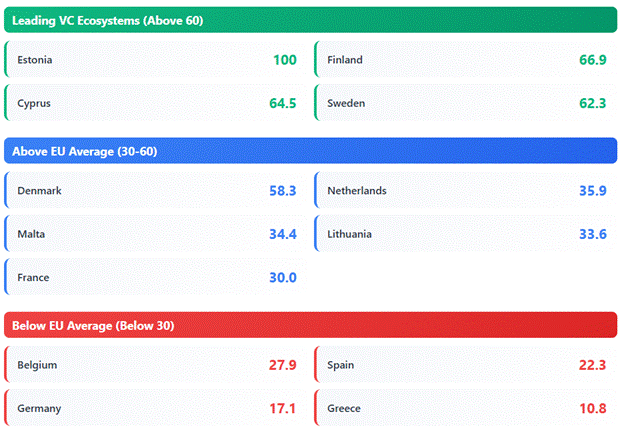
Estonia has more venture capital deals per GDP than anywhere else in the world. Cyprus ranks second among all EU countries for the number of VCs. The numbers for Germany and France are below the European average of 29.9, which is why many German and French startups attract investment from investors in London or relocate there temporarily.
EU Funding & Grant Access
Non-dilutive funding through EU programs and national grants may add time to your runway without giving up equity. There are many EU programs that fund innovation and growth in various areas such as: Horizon Europe (€93.5B, 2021-2027) for innovation projects, Digital Europe Programme (€8.1B) for digital transformation, and InvestEU (€27.2B guarantee fund) for scaling ventures. Access efficiency varies dramatically by country.
- Estonia leads in coordinated digital-focused programs. The country’s e-Residency and Startup Visa pathways connect directly to grant eligibility.
- “Business Finland” operates with notable efficiency, processing applications faster than most EU counterparts.
- The Netherlands structures its Innovation Box regime (effective 9% tax on qualifying IP income) alongside standard grant programs, creating dual incentives.
- “Portugal 2030” framework consolidates EU structural funds with national programs.
For founders focusing on non-dilutive capital, Estonia and the Netherlands offer the fastest route to incorporation and funded operations by providing quick registration with efficient digital grant systems.
Talent Availability & Cost
Median software engineer salaries across the EU range from €2,270 in Greece to €7,173 in the Netherlands – a difference that directly impacts how long your runway lasts. Lower salaries typically extend your burn rate. However, it is generally accompanied by a smaller talent pool of qualified candidates as well as a less developed technology ecosystem. However, higher salaries allow you to hire talented engineers faster than in non-competitive markets, but also accelerate the depletion of funds.
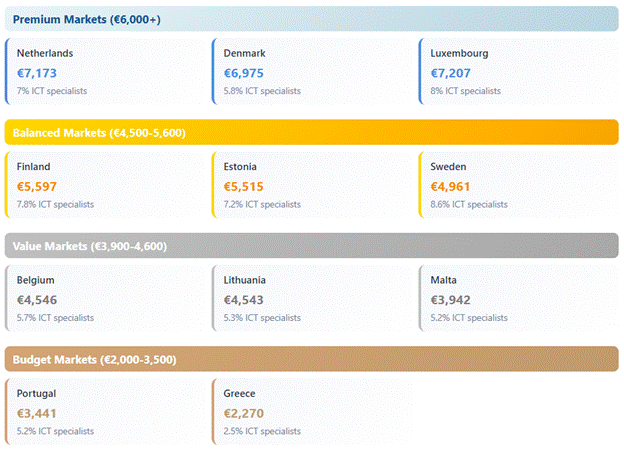
Sweden has the highest ICT specialist concentration (8.6%) at mid-range cost (€4,961) – faster hiring cycles and deeper talent pools without Western European price tags. Higher salaries generally correlate with larger available talent, though CEE markets like Lithuania offer respectable specialist percentages at significantly lower burn rates. Beyond ICT specialists, the broader digital skills population matters for non-technical roles. The Netherlands leads at 82.7% basic+ skills versus Romania’s 27.73%.
Language Barriers & International Accessibility
English proficiency directly impacts hiring speed, legal processes, and daily operations for international founders. The 2025 EF English Proficiency Index reveals stark differences across EU markets.
The country with the highest overall English proficiency rating is the Netherlands, with a score of 624. Portugal (612), Denmark (611), Sweden (609), and Belgium (608) are also in the top-tier category. Greece scores 592, Hungary- 590, while Czechia demonstrates 582. This indicates that they have capable populations, but they are generally less fluent in English.
Estonia and Lithuania, albeit not fully ranked, showcase profound English proficiency in technological sectors, allowing them to enter into digital businesses easily. Malta, on the other hand, operates as a bilingual market; having English as an official language opens opportunities for startup creation.
Countries with 600+ EPI scores typically offer legal services in English, such as accounting firms and various government processes. Thus, digital businesses do not have to rely on local actors with local language proficiency to build something, unlike more conventional sectors, and knowledge of English allows to conduct contracts, perform tax compliance, and investor communication. Nordic and Benelux markets eliminate language friction almost entirely, while Southern and Eastern European markets demand some level of proficiency in the native tongue to get started.
Bottom Line
No single EU country optimizes every variable. While Estonia delivers the most efficient path to operation with unique deferred taxation and bootstrapping for tech businesses, the Netherlands combines first-rate infrastructure with exit-friendly holding structures, ideal for VC-backed startups targeting US acquisition. In the Nordics, Sweden offers an optimal density of VCs, talent, incubators and environments to nurture the next big thing. Island countries, Malta and Cyprus, provide tax efficiency through complex refund systems requiring sophisticated structuring.
At the end of the day, everything comes down to a single critical decision: optimize for growth and expansion or start looking into an exit. Both early-stage and seasoned founders prioritize various goals in their business. Some go for a moonshot and rely on pure speed, others move cautiously, preparing for their long-awaited Series A. The EU countries can offer different benefits depending on the stage and the objective, which help fresh entrepreneurs on their challenging journey.
Methodology
To evaluate which European countries offer the best digital infrastructure for startups, we analyzed 27 EU member states across three key metrics: Digital Infrastructure Readiness, ICT Specialist Availability & Cost, and Venture Capital Access. Each metric was normalized to a 0-100 scale using Z-scoring and weighted equally (33.3% each) to calculate the final Digital Launchpad Index score. Corporate tax rates were included as contextual information but not factored into the index score.
Data Sources:
- Digital Economy and Society Index (DESI) 2025: Business digitalization scores, cloud adoption rates, digital intensity, high-speed coverage, ICT specialists, digital skills, AI adoption, and digital public services (European Commission)
- Levels.fyi Salary Database 2026: Median software engineer salaries by country for professionals with 0-2 years of experience, converted to EUR using ECB exchange rates
- WIPO Global Innovation Index 2025: VC Activity Score measuring venture capital deal count per billion PPP$ GDP (normalized 0-100), sourced from Crunchbase, Dealroom, and PitchBook 2024 data
- Tax Foundation 2026: Corporate income tax rates across EU member states
Scoring Criteria:
Countries with higher DESI Business Z-scores, lower ICT specialist salaries, and higher VC Activity Scores received higher rankings. The three metrics capture distinct startup needs: technical infrastructure to operate, affordable talent to build, and funding access to scale. All data is accurate as of January 2026.